–> Blogbeitrag auf Deutsch lesen
Contribution by Corinna Borer
Why sustainable skills are more than just environmental knowledge
Sustainability can no longer be reduced to individual environmental projects. Climate change, biodiversity loss, resource scarcity and global inequalities are transforming the way we learn, work, manage our economies and live together. This makes sustainability a question of competence: what skills do people need to understand these changes and help to shape them responsibly?
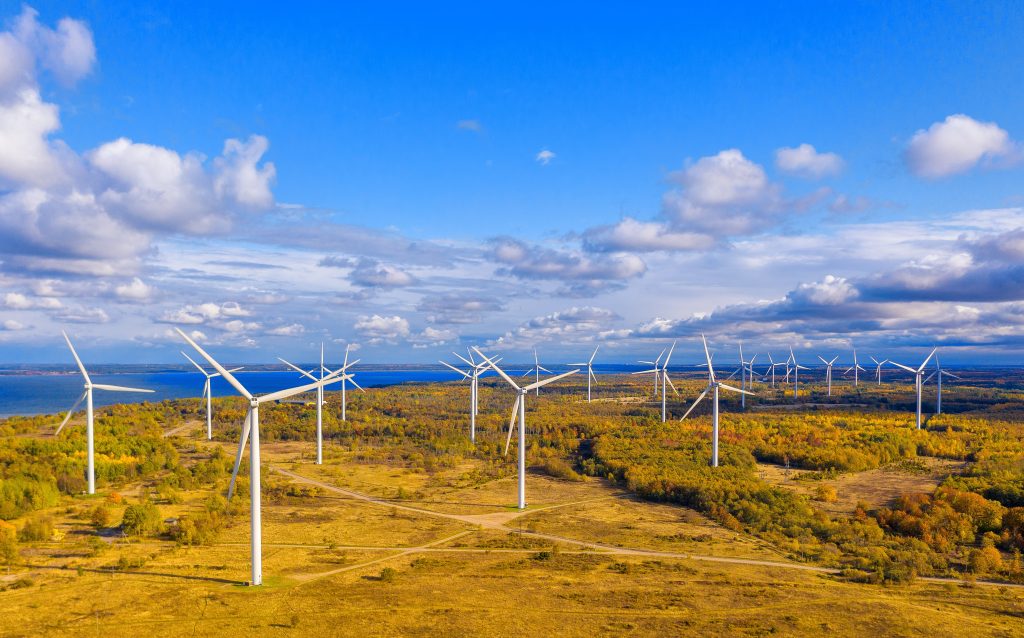
The Paldiski wind farm by the Baltic Sea. (Picture: Della_Liner / stock.adobe.com)
In this context, there is increasing talk of Green Skills. The term sounds promising, but still needs explaining. During my continuing professional development time, I spoke with teachers from various educational backgrounds in primary and vocational education and visited schools in Estonia and Finland. Both countries have highly regarded education systems and have undergone historical developments that I found particularly interesting. It became clear to me during these discussions that Green Skills, Greening, Green Life Skills and Education for Sustainable Development (ESD) are considered important, yet often remain marginal topics or are perceived as buzzwords. This is precisely why it is worth taking a closer look: what are Green Skills, and what do they mean for lifelong learning?
Green Skills: Future Skills with a Sustainability Compass
Green skills is a term that is defined differently depending on the context. It is often understood to refer to the skills people need to contribute to a resource-efficient, climate-friendly and sustainable economy and society. In the narrowest sense, it refers to technical and specialist skills for so-called «green jobs», for example in renewable energy, energy efficiency, sustainable construction, the circular economy or environmental management.
However, this understanding falls short when it comes to education. Green Skills also encompass systemic thinking, critical judgement, cooperation, communication, forward thinking, as well as dealing with uncertainty and conflicting objectives. The term «Green Life Skills», coined by Kwauk and Casey (2021), broadens the perspective further: the aim is for people to understand the roots of ecological and social crises, recognise their own scope for action and take responsibility in everyday life, within organisations and in society.
Green Skills are therefore closely linked to the 2030 Agenda and the Sustainable Development Goals. In this context, sustainability means not only climate protection, but also education, health, justice, decent work, sustainable consumption and strong institutions.
Green Skills overlap with Future Skills, but have a clearer normative focus: they ask not only what skills people need for the future, but also how this future can be shaped in a sustainable, fair and responsible way. In short: Green Skills are Future Skills with a sustainability compass.
Understand first, then act
In my discussions with stakeholders in vocational and adult education in Finland, it became clear that Green Skills are sometimes perceived as just a fad. If the term «green» is used hastily without clarifying what it means, it becomes a meaningless label.
This is precisely why a fundamental understanding is needed first: how do the environment, society and the economy function? How are environmental resources, consumption, work and community life interconnected? It is only on this basis that skills can emerge which go beyond superficial adaptation.
At SYKLI, a Finnish environmental college, it became clearer to me just how great the need for continuing education is. Sustainability must be translated into vocational and organisational practice and put into action: how do we use resources? How can organisations and companies plan and work more sustainably? And what skills do specialists, managers and teachers need to implement change processes?
Understanding Sustainability as a Skill
A useful reference framework for that is GreenComp, the European competence framework for sustainability. It is based on the 2019 European Green Deal and describes sustainability as a competence across four areas: embodying sustainability values, embracing complexity, designing sustainable futures, and taking action for sustainability.
GreenComp makes it clear that sustainability competence goes beyond mere knowledge. Learners should be able to reflect on values, understand systems, recognise conflicting objectives, envisage future scenarios and take action. This is precisely where the strength of Green Skills lies: they ask not only what people should know about sustainability, but also what they need to put sustainability into practice in specific situations.
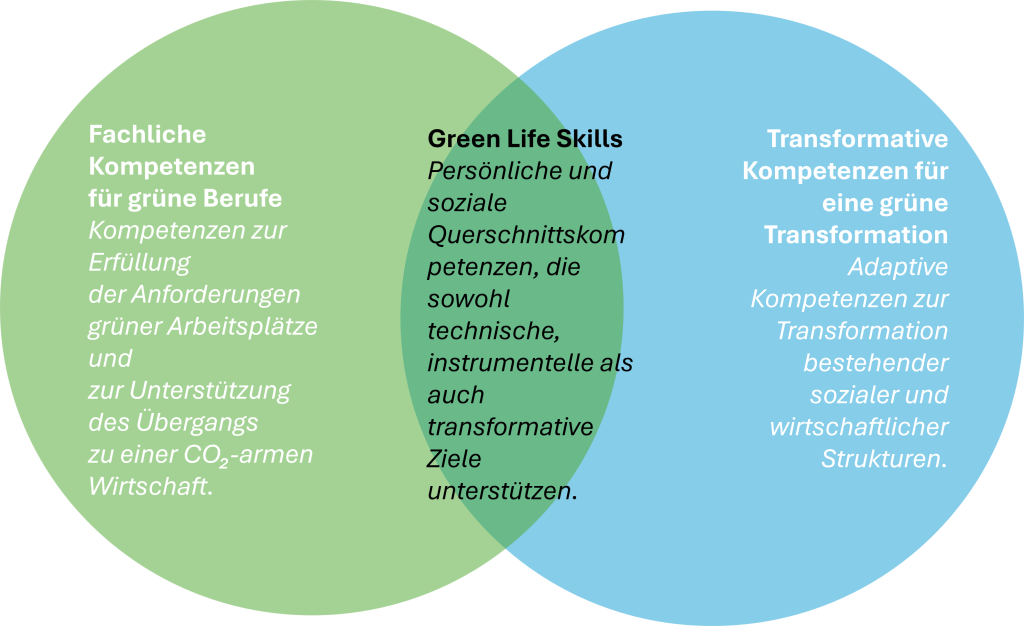
An important point of reference is Education for Sustainable Development (ESD). ESD asks how people learn to make good decisions for a sustainable future – in everyday life, at work and as part of society. Green Skills build on this and specify more precisely which abilities are needed: recognising interconnections, taking different perspectives into account, managing conflicting goals and taking action. In this way, sustainability is not merely discussed, but applied and practised in specific situations.
Starting with the Individual – and involving the Institution
During my visit to Gaia School in Tallinn, it became clear just how early Green Skills can be introduced. The school is guided by the Gaia Education philosophy of «healthy person, healthy community, healthy world». Sustainability is understood not merely as an environmental issue, but as a relationship: with oneself, with the community and with the world.
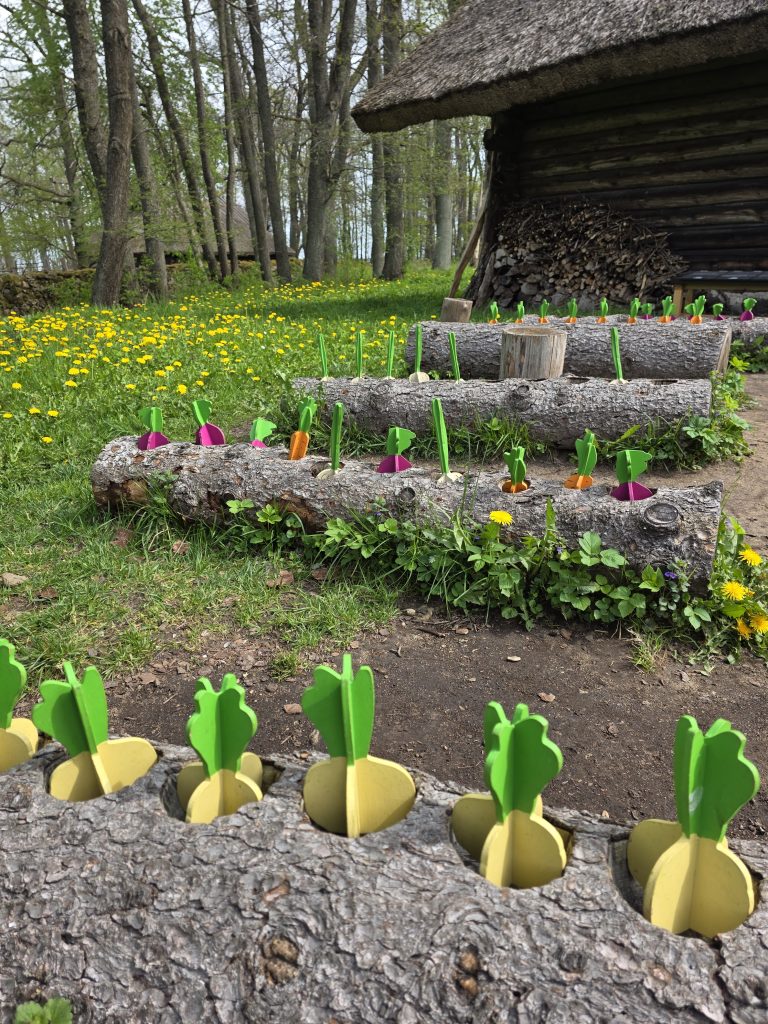
Whether in the classroom or out in nature (outdoor schooling), children practise expressing their opinions, listening to others, observing, presenting themselves and working together to find solutions. For example, they learn where food comes from, how fruit and vegetables are grown, and the role of natural cycles in a sustainable future. In doing so, they develop crucial skills for sustainable action, such as self-awareness, understanding interconnections and taking responsibility within a community.
Green Skills, therefore, do not begin with vocational training. They emerge where people learn to be mindful of themselves, others and the world. At the same time, they require institutions that enable sustainable thinking and action in everyday life – in teaching, school culture, leadership, participation and collaboration.
Higher Education Institutions: teaching and practising Sustainability
Universities of teacher education therefore have a dual responsibility. They are responsible for training and providing further training for teachers, trainers, school leaders and other professionals, who are expected to promote Green Skills within educational organisations. At the same time, higher education institutions must credibly promote and practise sustainability within their own organisation.
The fact that Green Skills nowadays go far beyond environmental knowledge is illustrated by European Erasmus+ projects such as ComeThinkAgain, in which the PH Zurich is involved as a partner institution, and Personal Green Skills in Higher Education, which is being implemented by the University of Applied Sciences Würzburg-Schweinfurt in collaboration with European partners. Both projects link sustainability skills with digital thinking, entrepreneurship, continuing professional development and train-the-trainer approaches.
For the PH Zurich, the sustainability policy provides an institutional framework. What is crucial, however, is how this is reflected in everyday life: in teaching, mobility, catering, procurement, digitalisation and collaboration.
Lecturers do not need to be perfect role models. They should rather highlight interconnections, reveal conflicting objectives and develop options for action with their students. A key GreenComp competence in this context is systemic thinking, which involves considering sustainability issues in the context of their ecological, social, economic and global dimensions rather than in isolation.
Green Skills are therefore less a ready-made catalogue of competencies than a shared learning task — in teaching, university culture and concrete action. So if Green Skills are to be more than just a buzzword, where in our field of education could we start with the «green» aspect — knowledge, attitude, communication, organisation or concrete action?
INFOBOX

Projects

In the context of international educational development, the question of Green Skills is particularly challenging: the green transition is global, yet manifests itself very differently at a local level. For this reason, Green Skills cannot simply be transferred as a ready-made list of competencies, but must be developed in collaboration with local partners. This is where the Project FutureS in the Republic of Moldova comes in. In the project, Future and Green Skills are understood from a cross-cutting perspective – in teaching materials, in the continuing teacher education, in school development processes and in collaboration with local partner institutions.

ComeThinkAgain, another project of the PH Zürich, combines computational thinking, entrepreneurship education and Green Skills in vocational and higher education.

Further information/Literature

- GreenComp provides an European competence framework for sustainability and distinguishes between four areas: values, complexity, future and action.
Guia Bianchi, Ulrike Pisiotis & Marcelino Cabrera Giraldez, 2022: GreenComp: The European Sustainability Competence Framework

- Gaia Education / Gaia YES! supports teachers and educational institutions in Education for Sustainable Development.
Gaia Education, o. J.: Gaia YES! Curriculum for Teachers and Educators
About the Author
Corinna Borer is a lecturer in Global Learning and a project leader in the The Centre for Global Education and Cooperation at PH Zurich.


